
Any questions?
+34 655 641 050 >
 Alfa Romeo
 Audi
Audi
 Bentley
 BMW
BMW
 Cadillac
 Chevrolet
 Chrysler
 Citroen
 Dacia
Dacia
 Daewoo
 DAF
DAF
 Dodge
Dodge
 Ferrari
 Fiat
Fiat
 Ford
Ford
 GMC
GMC
 Honda
Honda
 Hummer
 Hyundai
 Infiniti
 Iveco
Iveco
 Jaguar
 Jeep
Jeep
 Kia
Kia
 Lada
Lada
 Lamborghini
 Lancia
 Land Rover
 MAN
MAN
 Maserati
 Maybach
 Mazda
Mazda
 Mercedes Benz
 MG
MG
 Microcar
 Mini
Mitsubishi
Mini
Mitsubishi
 Multicar
 Nissan
 Opel
Opel
 Peugeot
 Porsche
 Renault
 Rover
Rover
 SAAB
SAAB
 Seat
Seat
 Skoda
Skoda
 Smart
Smart
 SsangYong
 Subaru
 Susuki
 Toyota
 Volkswagen
 Volvo
Volvo
 Immobiliser deactivation in Murcia
 Car key copying in Murcia
 Particulate filter cleaning in Murcia
 Lost car keys in Murcia
 Hybrid and electric car battery repair in Murcia
 ECU repair in Murcia
Instrument cluster repair in Murcia
ECU repair in Murcia
Instrument cluster repair in Murcia
 Electric power steering repair in Murcia
 Car key repair in Murcia
 ABS module repair in Murcia
 CAS module repair in Murcia
 FRM module repair in Murcia
 SRS module repair in Murcia
 Renault and Dacia UCH repair in Murcia
ECU remapping in Murcia
Renault and Dacia UCH repair in Murcia
ECU remapping in Murcia
 Car key cards in Murcia
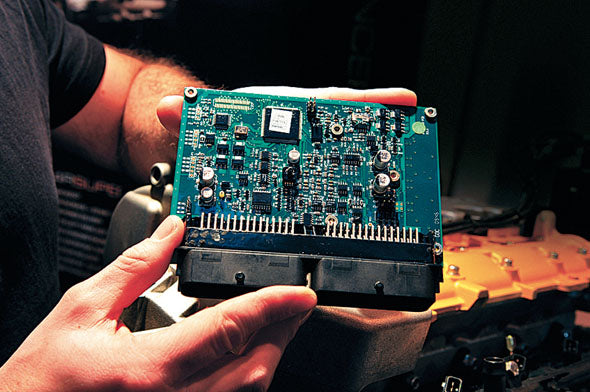
Heavy rain, pressure washing and floods can seriously affect a vehicle's electronics. A wet ECU can cause baffling intermittent faults or leave the car completely inoperative — and not always immediately: moisture is, by a long way, the most common cause of ECU failure we see in the workshop, and the most treacherous, because corrosion creeps on silently for weeks before showing itself.
Depending on the model, they may be located in:
Knowing where yours is helps you act quickly in the event of a leak: a damp floor mat on the passenger side, for example, is a warning sign that should never be ignored.
Any of these shortcuts can worsen the internal damage and make the ECU irreparable.
Yes, in most cases — if you act in time. At Ecumotorstock we open the unit, clean it with ultrasound, neutralise the corrosion and repair the affected tracks and components. Each unit is then tested on a simulation bench, reproducing its real operation before it is returned.
When the water has gone too far, two routes remain, and it is worth knowing them in order of preference:
Moisture produces erratic symptoms that are easily mistaken for sensor or wiring faults. Before investing in repair or replacement, you can test the car with another unit through our ECU rental service: if the car works with the test unit, the diagnosis is done.
There is not always a puddle to give it away. An ECU with accumulated moisture usually warns you like this, weeks after the leak:
If you recognise this picture and there was an episode involving water — a flood, a pressure wash, a soaked floor mat — do not wait for the final failure: at an early stage, cleaning and repair have a much higher success rate.
A wet ECU is not a death sentence, but it is a race against the clock: disconnecting the battery, not insisting on starting the car and putting it in expert hands as soon as possible make the difference between a repair and a replacement.
If your ECU has got wet, request collection from your home or your workshop: we assess it, tell you without obligation whether it is recoverable and return it to you repaired, bench-tested and with a warranty. See our ECU repair service.
{"one"=>"Select 2 or 3 items to compare", "other"=>"{{ count }} of 3 items selected"}
 ECU cloning
 ECU rental
 BCM repair
 ECU sales
 Audi
Audi
 Lexus
Lexus
Leave a comment